
| Amidst the era of digitization, the medical and healthcare fields are rapidly evolving, driven by the adoption of electronic health records and clinical information systems. These advancements pave the way for significant improvements in patient care and health outcomes through digital health platforms. Recognizing the potential of technology in medicine, the Vrije Universiteit Brussel (VUB) launched the Research Centre for Digital Medicine (REDM) in mid-2023. REDM is an interdisciplinary initiative aimed at integrating advancements in technology, data science, and healthcare innovation. The research group comprises more than 60 members, including over 20 PhD students, clinicians, pharmacists, mathematicians, statisticians, biomedical scientists, and health services researchers. This diverse team works collaboratively to develop and implement innovative research methods in digital medicine, striving to enhance healthcare through intelligent, data-driven interventions. |
ManagementPieter Cornu, PhD (Chairman) Kurt Barbé, PhD (Research) Pieter Cornu, PhD (Tech Transfer) Mark De Ridder, MD, PhD (Communication) Nicole Pouliart, MD, PhD (Innovation, evaluation of health care services) Gert Van Gompel, MD, PhD (Open Access/Data) Adminstrative supportTom Janssen |
Our Research Areas
Biostatistics and
Epidemiology
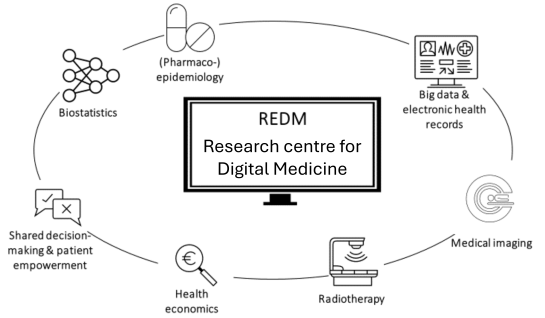
This research area focuses on the intersection of medical science, advanced technology and quantitative modelling. We develop new machine-learning techniques as well as novel epidemiological approaches within the field of pharmaco-epidemiology and other biomedical applications. A central component is the modelling of raw medical data directly obtained from clinical instrumentation, enabling prediction of clinical outcomes, exploration of biological mechanisms, optimisation of experimental design and reduction of measurement uncertainty. To achieve this, statistical models are explicitly grounded in mathematical biology, ensuring that the underlying data-generating mechanisms are incorporated in a scientifically coherent way. This integrated approach supports research ranging from risk estimation and drug-safety assessment to biomarker discovery and dynamic patient monitoring. By combining methodological innovation with practical clinical relevance, the work contributes to more reliable evidence generation and improved translation of data into medical decision making.
Big data and
digital health data platforms
The growing emphasis on evidence-based medicine and shared decision making has created a strong need for personalised prognosis and robust clinical insights based on extensive datasets. Administrative records and routinely collected hospital data offer an accessible, low-cost and time-efficient source for research in both hospital settings and population-level health services. Within this context, REDM uses hospital data platforms to advance research in Clinical Decision Support (CDS) and health-data intelligence. The UZ Brussel Digital Health Platform provides a large integrated research environment where classical statistical models and machine-learning methods can be applied to complex clinical questions. Furthermore, by linking large administrative datasets—including claims data, minimal hospital data, the Crossroads Bank for Social Security, cancer registry information and occupational health datasets—prediction modelling at population scale becomes possible. This enables detailed analysis of care pathways, cost-effectiveness, service utilisation and the impact of innovative health-care interventions on outcomes across diverse patient groups.
Innovation and
evaluation of health care services
A strong anchoring with innovative clinical work and studies at the UZ Brussel (radiotherapy service, radiology service, clinical pharmacy, information processing service) provides a means for strong data-driven research into the development of innovative radiation sensitising strategies and biological testing of digital concepts such as radiomics. This includes fundamental, wet lab based, and clinical research. Additonally, within the radiology domain, an interuniversity project focuses on magnetic resonance (MR) diffusion and perfusion and application to the characterisation of healthy and pathologic tissues, for which the research infrastructure of the 7t-MRI-project is expanded with a powerful MRI scanner boasting a magnetic field strength of 7 tesla (T). It will make it possible to manage dementia, epilepsy, cartilage degeneration, muscle fatigue, kidney disease and tumors of different organs. The potential impact of improved clinical decision making, predictive modelling and innovations in health care in terms of costs and effectiveness will also be addressed to facilitate the implementation of new knowledge into health care practice and policy. To reach informed and shared decisions about e-Health solutions to improve patient well-being and empowerment is a final focus, especially for vulnerable patients like elderly, and those with lower health literacy.